
The Most Important Processes No One Notices Until They Fail
The Most Important Processes No One Notices Until They Fail

The student taps their phone outside the residence hall. Nothing happens.
At first, it looks like a simple access problem.
Then Housing receives calls. Dining begins hearing reports of inconsistent transactions. IT starts checking integrations. Someone verifies the credential system. Another team checks schedules and permissions.
Within an hour, what appeared to be a single issue becomes a cross-campus operational response.
Most campus communities never see the dozens of processes operating behind the scenes that make daily life feel seamless. And that's exactly the point.
The most important operational systems are often the least visible.
Across higher education, campus card and credential teams manage infrastructure that quietly supports identity, access, transactions, security, and service delivery every day. Students experience convenience. Staff experience continuity. Leadership experiences smooth operations.
Underneath those outcomes is a web of processes that only become visible when something stops working.
The Systems Most People Never See
A modern campus credential is much more than an ID card.
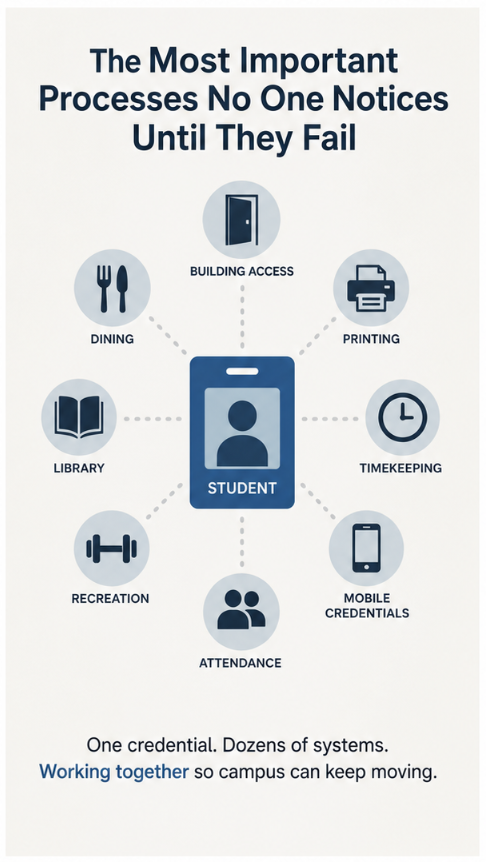
At many institutions, one credential enables access to residence halls, dining services, printers, libraries, recreation facilities, attendance systems, mobile credentials, timekeeping platforms, and more.
What appears simple to the user is often supported by dozens of integrations and automated workflows.
Chris Bird from Bowdoin College described it this way:"Synchronizing card data across multiple systems, multiple times a day, is what enables our entire onecard ecosystem to function."
At Bowdoin, a single dual-technology credential supports meals, building access, timeclocks, printers, and library services. Every new credential issuance depends on multiple systems recognizing and processing those changes quickly and accurately.
Bird noted that because most of this work is automated, users rarely think about it until data stops flowing. "When automated processes break and the data isn't flowing, the impact can range from affecting a single patron, to an entire department, or to all devices of a certain type, and quickly become a college-wide issue that needs to be immediately addressed."
Small Processes, Large Impact
Operational disruptions rarely begin with dramatic failures. More often, they begin with details.
Bird shared one example that illustrates how quickly small decisions can become campus-wide events. "An '8' instead of a '9', entered into a calendar months earlier caused a problem that no one noticed until everyone did." A calendar typo caused every student to lose residence hall access 24 hours earlier than intended.
Security received calls. Residential Life received calls. The OneCard Office received calls.
The team restored service by assigning temporary permissions and then redesigned their processes to require additional cross-checking and reduce unnecessary schedule complexity.
Other institutions described similar ripple effects. At Florida International University, Ricky Sant highlighted how a hardware issue can quietly expand into a broader operational response. "On a handful of occasions, I have had Squadron controllers stop working. When this happens, it could affect access control anywhere from 2 to 20 doors."
Resolving those incidents is rarely as simple as swapping hardware. It may require troubleshooting, replacing controllers, registering MAC addresses, configuring IP assignments, and coordinating with network security teams before normal operations return.
At Georgian College, Jennifer McDonald shared an example where identity data created an unexpected barrier. Their institution occasionally reuses inactive email addresses for students with matching names. Their ONEcard platform, however, doesn’t allow duplicate email identities for portal access.
The result? Students with correct credentials couldn’t access their accounts. The root cause was difficult to identify because the visible problem looked like a login issue while the actual issue originated elsewhere in the identity ecosystem.
These examples share something important: Operational failures are rarely isolated. The visible problem is often only the final symptom.
The Quiet Work That Keeps Campus Moving
When campus systems function properly, most users never see the effort involved. They don’t see:
- Monitoring system health and transaction activity
- Verifying data synchronization across platforms
- Auditing permissions and credential status
- Updating lock firmware and replacing hardware
- Running automated reports and reconciling records
- Managing onboarding and offboarding workflows
- Testing integrations before issues reach users
- Performing preventative maintenance during breaks and closures
McDonald emphasized how much continuity depends on automation, saying "Various systems rely on the data provided in automated reports to ensure that access to services continue, accounts reconcile, and information flows accurately." She noted that manual replacement of those reporting processes would be difficult, and likely impossible, at scale.
At Florida International University, proactive maintenance includes monitoring access software, replacing lock batteries before failure, cleaning readers annually, and updating firmware across devices and gateways. Sant explained: "We proactively monitor our access control software… so usually we are aware of any doors that go offline."
Bird offered another reminder of what invisible success looks like: "Many students go through all four years without ever needing to consider that their door lock is battery-powered because of the work we do over breaks and housing closures."
At Washington University in St. Louis, Stephen Asbeck described the work people rarely associate with credential operations: daily and weekly audits, HR termination processing, lock schedule management, and producing space utilization reports that support broader campus planning.
Success often looks uneventful. That doesn’t mean it’s simple.
Coordination Is the Infrastructure
Campus credential operations don’t succeed in isolation. Behind every successful deployment or resolved incident is coordination between teams that each manage part of the experience.
Members repeatedly pointed to close partnerships with Information Technology, Housing and Residential Life, Dining Services, Public Safety, Facilities, Registrar, Human Resources, Network Operations, security teams, and vendors and integration partners.
Bird described Facilities and IT as indispensable partners for maintaining infrastructure while Residential Life and Dining help shape the business processes that directly affect students.
Sant emphasized that troubleshooting often requires multiple specialists. He said, "Each team has a role to play."
A controller issue may involve network switching, security approvals, access platforms, locksmith support, and external integrators.
Asbeck reinforced the same theme: "Coordination among these teams is essential to maintaining campus access and safety."
These relationships matter because operational systems increasingly depend on shared ownership.
A door reader issue may involve networking. A credential problem may originate in identity data. An access issue may begin with scheduling. A concern regarding the student experience may ultimately trace back to infrastructure decisions made months earlier.
The systems are connected because campus experiences are connected.
Actions You Can Take
Understanding the complexity is one thing. Doing something about it is another.
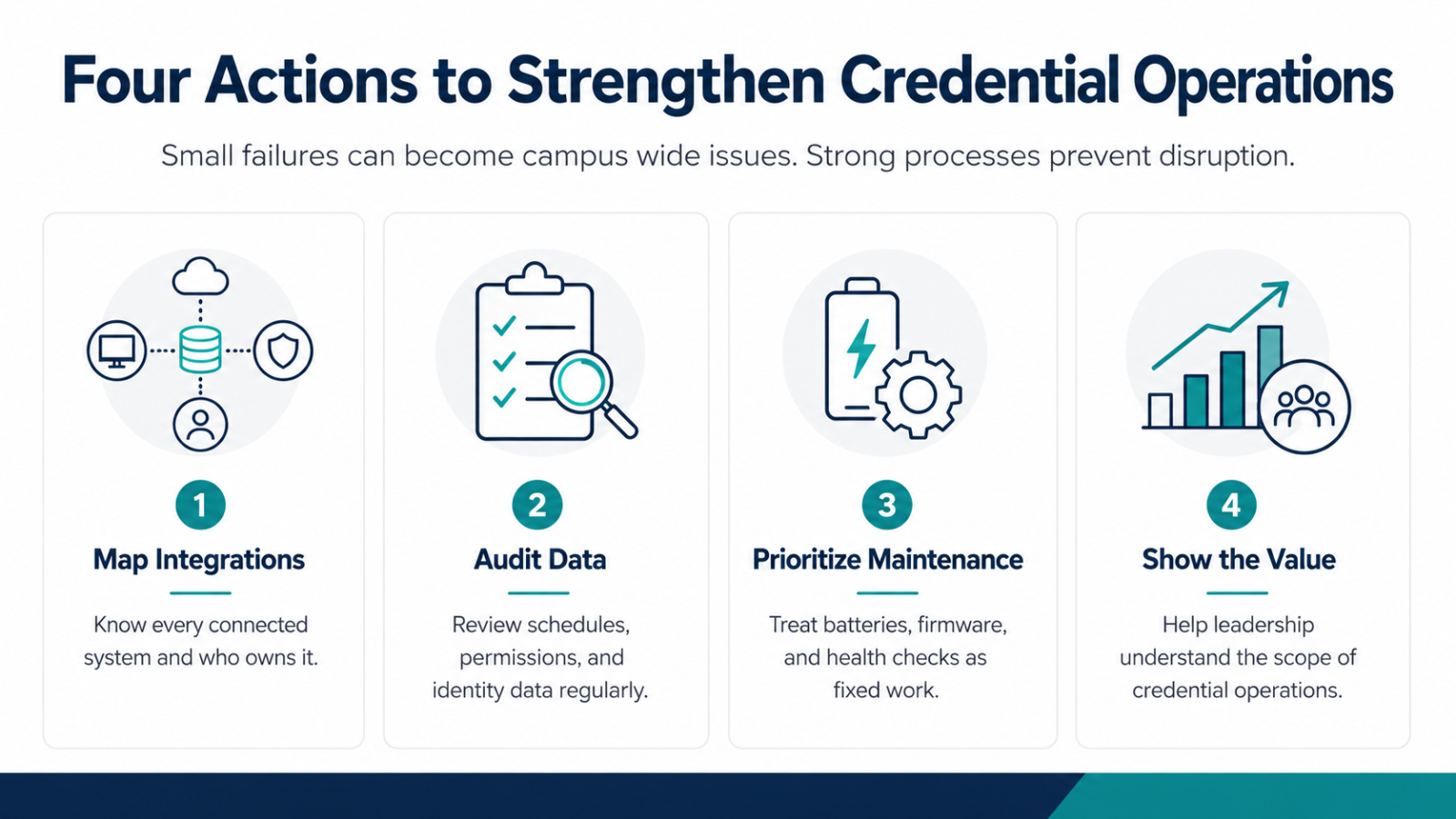
Here are four actions you can take now, regardless of your institution size or system maturity.
- Map your integrations and assign ownership.
List every system your credential platform touches — access control, dining, identity, HR, library, print, timekeeping, and anything else. For each one, document who owns it, who to call when it breaks, and how quickly your team can trace a failure from the visible symptom back to the source. If you cannot answer those questions quickly, the gap is worth closing before an incident forces you to find out under pressure. - Audit your schedules, permissions, and identity data…with a second set of eyes.
The "8 instead of a 9" example is not unusual. Small data entry errors, stale permissions, and identity mismatches accumulate quietly and surface at the worst moments. Schedule a regular review at least on a quarterly basis and involve at least one person outside your immediate team. A fresh perspective often catches what familiarity misses. - Treat preventative maintenance as non-negotiable, not optional.
Battery replacements, firmware updates, reader cleaning, and integration health checks aren’t tasks to defer until it’s at a time that is convenient. Build them into your calendar as fixed commitments. Document what was done and when. If your team can’t currently sustain that schedule, that is a resource conversation worth having with leadership. The examples in this article give you concrete language to make that case. - Make the invisible visible to the people who control your budget.
Most administrators and campus leaders don’t understand what credential operations actually encompass. That is partly by design because invisibility signals success. However, it also makes it harder to secure resources, justify staffing, and build organizational resilience. Consider a one-page briefing, an annual report, or even a brief walk-through for key partners that shows the scope of what your team manages. You shouldn’t have to wait for an outage to earn that visibility.
Invisible Success Is Still Success
Many campuses process millions of credential transactions each year. Yet most people only experience a tiny piece of that ecosystem.
They tap. They enter. They move on.
Bird offered one final perspective: "Most only see their own building or the few buildings they work in regularly, and don't realize the full scope." He noted that institutions can accumulate technical debt if hardware and software lifecycles are not actively managed, and eventually face expensive decisions when unsupported systems fail.
McDonald compared campus card operations to something most people understand immediately - an internet outage. You can still function. But everything becomes slower, less convenient, and less secure.
Asbeck put it another way: "Our team does much more than add individuals to the system and produce badges."
Credential operations aren’t just support functions. They are infrastructure. When they work well because your team does the work, everything else does too.
Special Thanks to this Blog Post’s Contributors:
-
Stephen Asbeck, Washington University in St. Louis
-
Chris Bird, Bowdoin College
-
Jennifer McDonald, Georgian College
-
Ricky Sant, Florida International University