
When a Merchant Joins Your Card Program, the Work Is Just Beginning
When a Merchant Joins Your Card Program, the Work Is Just Beginning

When Sean Stewart takes his kids out to eat, he often chooses a restaurant that accepts BuckID.
Some of that is convenience. He already has money in his BuckID account. There is another reason, though. As he put it during a recent NACCU webinar, “It’s important that you support the people who are in business with you.”
That comment says a lot about merchant programs.
The reader on the counter and the transactions running through it are important. So are reimbursement schedules, commission rates, reporting, training, and the occasional refund after someone accidentally charges $99 for a $9 sandwich.
Underneath it all is a relationship between the campus and the merchant. Keeping that relationship useful takes more attention than adding a business to a website and placing a sticker on the door.
The Ohio State University has had plenty of time to learn this. Its off campus BuckID program began in 1995 with one Wendy’s location and now includes roughly 150 merchants. The program processes about $2 million in annual reimbursements through the brick and mortal program and another $7.5 million through a relationship with GrubHub, which helps generate substantial revenue for the card office.
During a recent NACCU webinar, Stewart and Tyler Wynkoop shared what keeps that program running. NACCU members from other institutions added their own experiences, including a few reminders about what happens when merchant relationships are allowed to coast.
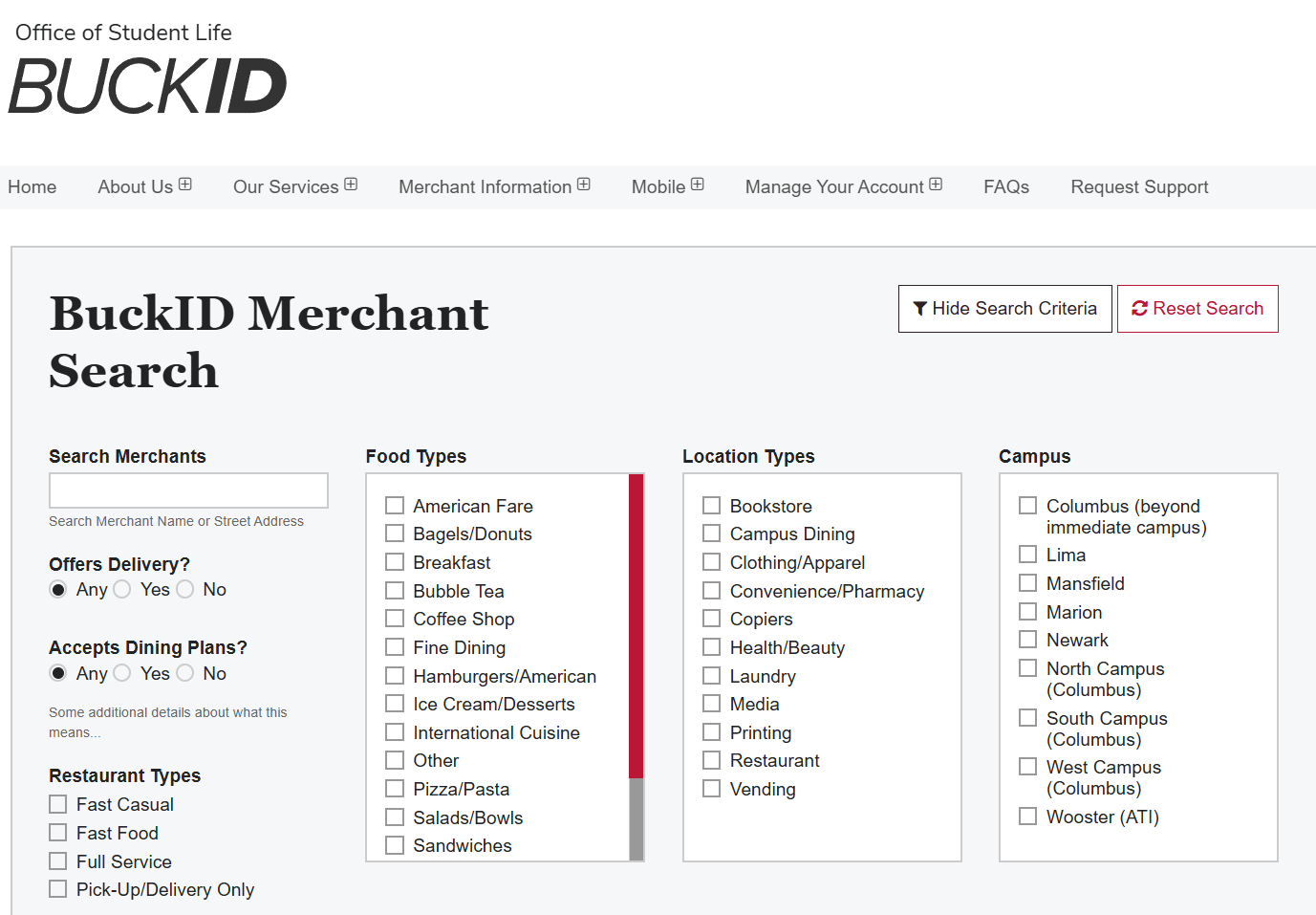
 A merchant directory can hide a lot of problems
One of Ohio State’s recurring challenges is finding out that a merchant has quietly stopped participating.
Sometimes the business has changed owners. Sometimes the reader has been pushed aside. Sometimes the current employees have no idea what BuckID is, even though the merchant is still listed on the university website. But the card office may not hear about it until a student tries to pay and gets turned away.
A webinar participant described a more frustrating version of the same problem when merchants continued to receive the marketing benefit of being listed as campus partners, but told students that the machine was broken and asked them to pay with debit or credit instead. That allowed the business to avoid the commission while keeping its place on the college website and its reputation as a campus partner. In other cases, new employees had simply never been trained.
A merchant can look active on paper long after the relationship has faded. Campuses could catch this earlier by reviewing locations with no recent transactions, confirming participation after an ownership change, and periodically checking whether merchant information is still accurate. A friendly call after an unusual stretch of inactivity may uncover a training problem before students encounter it.
Merchant training has a short shelf life
The employee who received the original training may be gone within a few months. The reader may still be sitting beside the register, but no one working that shift knows what to do with it.
Ohio State sees this most often with smaller businesses. Transactions may never get entered, staff may use the equipment incorrectly, or a student may be charged twice. The problem is rarely the equipment itself. It is usually turnover.
A good merchant launch should include instructions that remain useful after the person who signed the agreement has left. Give the manager a simple register guide. Make sure multiple employees know how the process works. Put the support number where staff can find it. Check back near the beginning of a new semester, when staffing changes are especially common.
Ownership changes deserve their own process. Ohio State sometimes has to divide reimbursements between the former and new owners, which becomes complicated when the card office learns about the sale after the fact.
Reimbursement options can help pay for the work
Ohio State’s standard commission depends on how often the merchant wants to be paid. Monthly reimbursement carries a 4 percent commission. Biweekly reimbursement is 4.5 percent, and weekly reimbursement is 5 percent. A few large partners have negotiated different rates. That structure gives merchants a choice. Businesses that want faster access to their money pay more for the additional processing.
Merchants can also receive sales reports, and their reimbursement information shows the amount collected, the university’s commission, and the amount deposited through ACH. Wynkoop reviews the activity according to each merchant’s payment schedule and confirms that the transaction system matches the reimbursement records.
The exact rates will be different at every institution. The useful idea is tying the price to the work. Weekly reconciliation creates more activity for the card office than monthly reconciliation. The agreement can reflect that.
Automation changes what a small staff can handle
When someone asked how many employees manage Ohio State’s off campus program, the answer was essentially the two people presenting the webinar.
That answer came with an important qualification. Ohio State has strong technical support and a homegrown Merchant Management System that tracks transactions and calculates reimbursements. Human review is still required, but staff are not rebuilding every payment from scratch.
The contrast with another campus was striking. One participant described preparing a separate check requisition in Microsoft Word for each merchant, calculating commissions in Excel, sending the paperwork to accounting, and waiting for electronic payments to be issued.
Those are two very different versions of merchant management.
Before recruiting another group of businesses, it may be worth following one transaction from the register all the way to reimbursement. Count how many people touch it. Look for information being typed more than once. Notice where someone has to remember to send a report or create a payment request. Look for opportunities to automate or consolidate processes. A growing off-campus program can remain manageable when routine work happens automatically and staff spend their time reviewing exceptions.
Promotion should reflect actual participation
Merchants value their connection to a campus.
Ohio State provides website listings, signs, merchant promotions, and door stickers showing that BuckID is accepted. Stewart noted that the sticker alone can help a business because students walking past immediately recognize that they can use their account there. That visibility has value and builds community trust, which is why inactive merchants should not continue receiving it indefinitely.
A listing should mean that students can reasonably expect the payment method to work. Removing an inactive merchant is not punishment. It protects students from making a trip based on outdated information, and it protects the credibility of the entire program.
Promotion can also be a reason to reconnect. A merchant of the month feature means more when the card office has recently confirmed that employees are trained, the reader is working, and students are being welcomed.
Every campus needs its own reason for having the program
Ohio State’s program brings in revenue that helps support the card office. That income may become more important as the university moves toward mobile credentials and produces fewer physical cards, reducing revenue from replacement fees.
At Swarthmore College, the original need was different. The dining hall had become too small for the student population, and nearby restaurants gave students more options while helping relieve long lines on campus. The program also directed student spending into the local community.
Another participant said the purpose of their program had always been about student service rather than revenue.
Those goals lead to different decisions about commission rates, merchant selection, staffing, and promotion.
A campus should know what it expects the program to accomplish. Success might be measured through student use, merchant retention, net revenue, staff time, or access to services the campus cannot provide itself. The answer can change over time, especially after a new dining facility opens or student habits shift.
Take care of the merchants you already have
There is always another restaurant, store, or service that could be added to the program. Growth is easy to count and looks good in a report. The condition of the existing relationships is harder to see.
Which merchants have gone quiet? Which ones still train new employees? Where are students encountering problems? Which businesses are enthusiastic enough to keep the campus sticker near the front door?
Those questions may be more useful than another recruitment target.
A healthy merchant program depends on ordinary things happening reliably. The student can pay. The employee knows what to do. The merchant receives the correct reimbursement. Someone answers when there is a problem.
And every now and then, the people who run the program stop by, use the account themselves, and support the businesses that chose to participate.
Watch the full webinar here: