
Using Student Feedback to Improve Card Services
Using Student Feedback to Improve Card Services
If you ask the icebreaker question, “If you could have any superpower, what would it be?” inevitably someone will respond that they want to ability to know what others are thinking. Guess what? You already have that superpower in your utility belt!
Do you survey your students, faculty, staff and other campus community members?
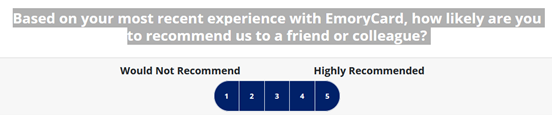
Kim Pfeffer, Director, EmoryCard at Emory University does. Anyone who visits EmoryCard, and signs in to iQueue, is sent to their Customer Service Survey immediately after the conclusion of their visit. The data is not broken-down by constituent type, so they consider all of it equally. Customer feedback has often led to direct changes – most recently, customers expressed frustration in finding their location, so EmoryCard staff updated the website to include a map and photos for ease of navigation.
Two questions yield great insights:
- Based on your most recent experience with EmoryCard, how likely are you to recommend us to a friend or colleague?
- What is the primary reason for your score? Is there anything we can do to improve your experience?
George Washington University sent a survey to all their mobile testers. They asked questions about the set-up process, places where it didn’t work, and what issues the testers experienced. They received 200 responses for a 40% participation rate!
Emily Dieker, Director of the GWorld Program reports “there were one or two technical issues that came up that we had not experienced. We used the survey responses to change the language we used and provided a screenshot of how to avoid the issue. Conducting the survey as part of our mobile test was super helpful before our launch.”
Purdue University has learned to send student satisfaction surveys at the beginning of spring semester for a higher response rate compared to surveys sent during fall semester. The mobile card satisfaction survey was sent to all populations in 2024 and targeted specific populations in their 2025 survey, including campus location specific (physical and online), customer type specific (students, fac/staff), and residents / workplace specific (on campus vs. off campus).
Rhonda Resler, Dana Analyst for ID Card Operations shared some statistics. The summary of the open-ended response to “Is there anything else you’d like to share with us about the mobile ID on your campus and / or your experience with it” netted 494 responses with a positive feedback count of 124 and negative feedback count of 48. Key themes included compatibility issues, scanning issues, access issues, and convenience. One constructive comment they focused on: “It would be wise to teach students about the "Transit Card" feature where the IOS device will still be readable as a PUID even if the phone is dead or locked. So many students struggle with the wallet open function, which in turn holds up lunch lines and the check-in desk at the CoRec.”
Both the George Washington University and Purdue University surveys are available at NACCU in The Vault.
Need more ideas? Distribute a survey at your card center! You can collect specific information while your customers are waiting, and you’ll be there to clarify or follow up. Ask where they wish their campus card worked. Filter those ideas down to the top five for a more focused survey and use that data to support expansion of your program.

Make it fun! Ask your customers about the best thing they buy with their flex dollars to generate engagement and award flex dollars randomly for responses. Is it pizza dough made by the local French bakery sold at the grocery store? A bibimbap bowl from the eatery one block off campus? Warm fuzzy socks from the outdoor gear store? Share those results in your social media posts and you’ll boost your off-campus merchants too.
Remember to take the good with the bad. It’s an opportunity to learn from feedback and improve your services. If you can’t fix someone’s problem, you can at least explain why. Don’t let the negative feedback sit and fester, especially online. Address it when possible.
Use social media for quick polls and to share results. Often just asking the question helps you advertise a new or improved service.
It’s time to activate your superpower and start asking questions to learn what your campus community thinks so you can improve your campus card services.