
What Campus Card Professionals Have in Common – No Matter the Campus
What Campus Card Professionals Have in Common – No Matter the Campus

Walk on to a campus at a tiny New England college or a sprawling Big Ten university and you’ll see two very different campuses. Different traditions, different enrollment numbers, different budgets, different vendor relationships. But spend five minutes talking to the professional behind the desk in the card office and a familiar portrait emerges.
You won’t find a degree program at any University for Campus Card Professional. Rather, most step into the position coming from another department on campus or began as a student worker and stayed in the card office after obtaining their degree.
Campus card professionals come from various backgrounds and have different levels of experience. To be a truly successful Campus Card Professional you must have a little experience in a variety of fields. Most successful Campus Card Professionals have some background in technology, student services, security, finance, and marketing. And wherever they work, they tend to share the same core traits, are under the same pressures, and find community in the same unspoken experiences.
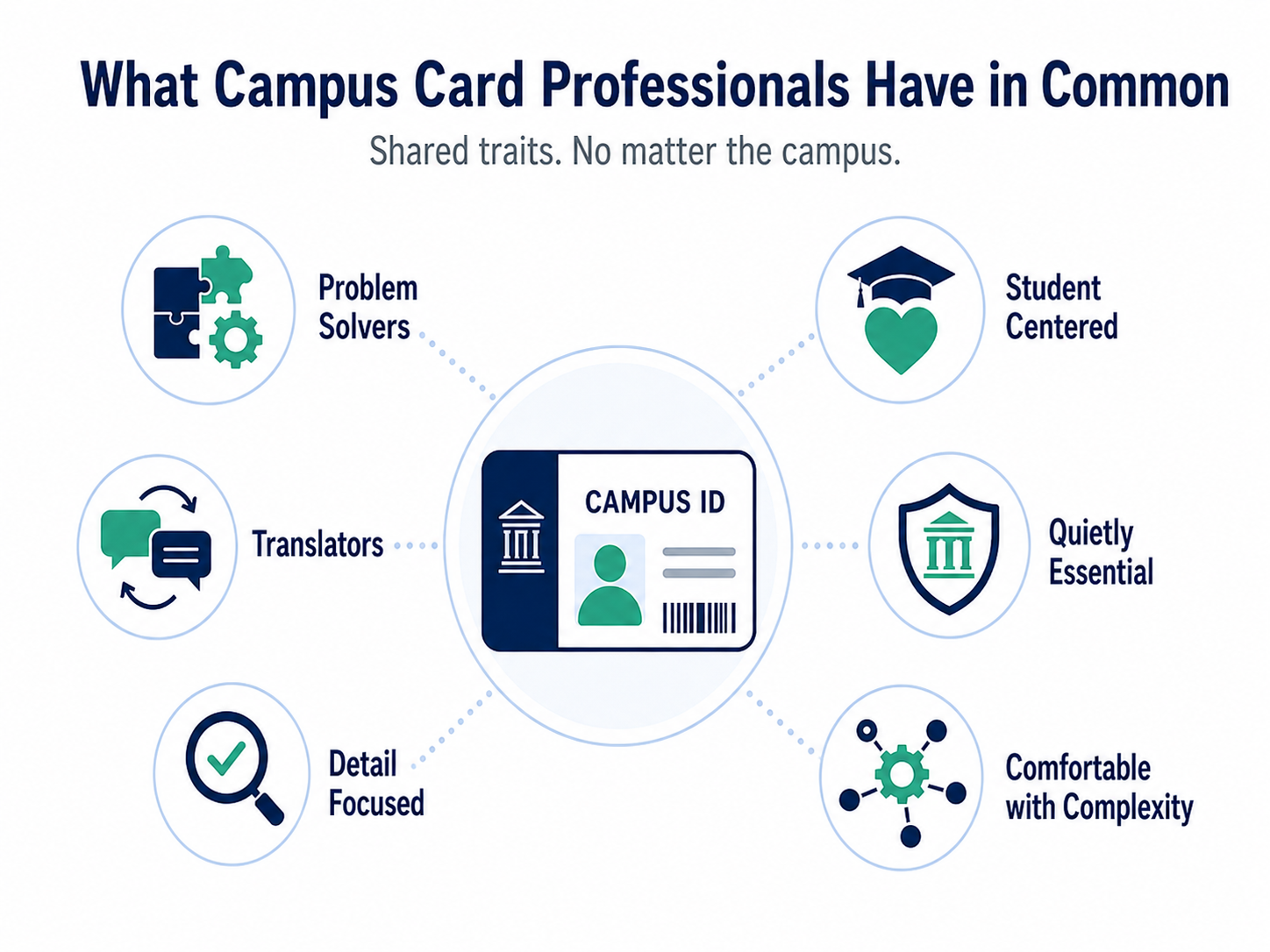
Common Traits
Relentless problem-solvers
When a card reader goes down at 2 a.m. before move-in day, there’s no waiting until Monday. Campus card pros develop a responsibility, and a determination, to get things working, no matter what.
Natural translators
They speak IT to IT, finance to finance, and student to student, often in the same afternoon. The ability to translate technical jargon into human language is a must! Being a liaison across departments and having the ability to work with a variety of people is key.
Detail-obsessed
A photo that doesn’t meet print specs, a declined dining transaction, a duplicate or missing record are all small errors that have large consequences. Accuracy is key.
I recall working on some reconciliation reports for dining. The reports were off by pennies. When asked why I was spending time on it, it’s just a few cents, I responded “But it isn’t right. It is money and it must be right”.
Quietly essential
We all think it, and most of us have said it: “Most people only notice the campus card office when something goes wrong”. Card pros have made peace with that invisibility and take pride in the seamlessness that earns it. Although a little recognition occasionally would be nice.
Genuinely student-centered
Often, the Card Office is one of the first places they visit on campus, where they go when they need assistance with meals, access or problem solving. Some students become “regulars” and will just stop in to visit or seek advice. These are the relationships that make students feel comfortable and can help them succeed.
Whether it’s reissuing a card for a student who lost theirs before finals or extending declining balance access for a family navigating hardship, campus card pros care deeply about the people they serve. There is also a sense of professional commitment that can’t be taught. These experiences are remembered by students and can help with student success.
Comfortable with complexity
Legacy systems, new integrations, regulatory compliance, and physical hardware - all in one role. They’ve learned to hold a lot of moving parts without dropping any of them.
How many of us have said, “I didn’t know what a campus card office was when I took this job.” Or “I didn’t go to school for this, but I think I have a real knack for it.”?
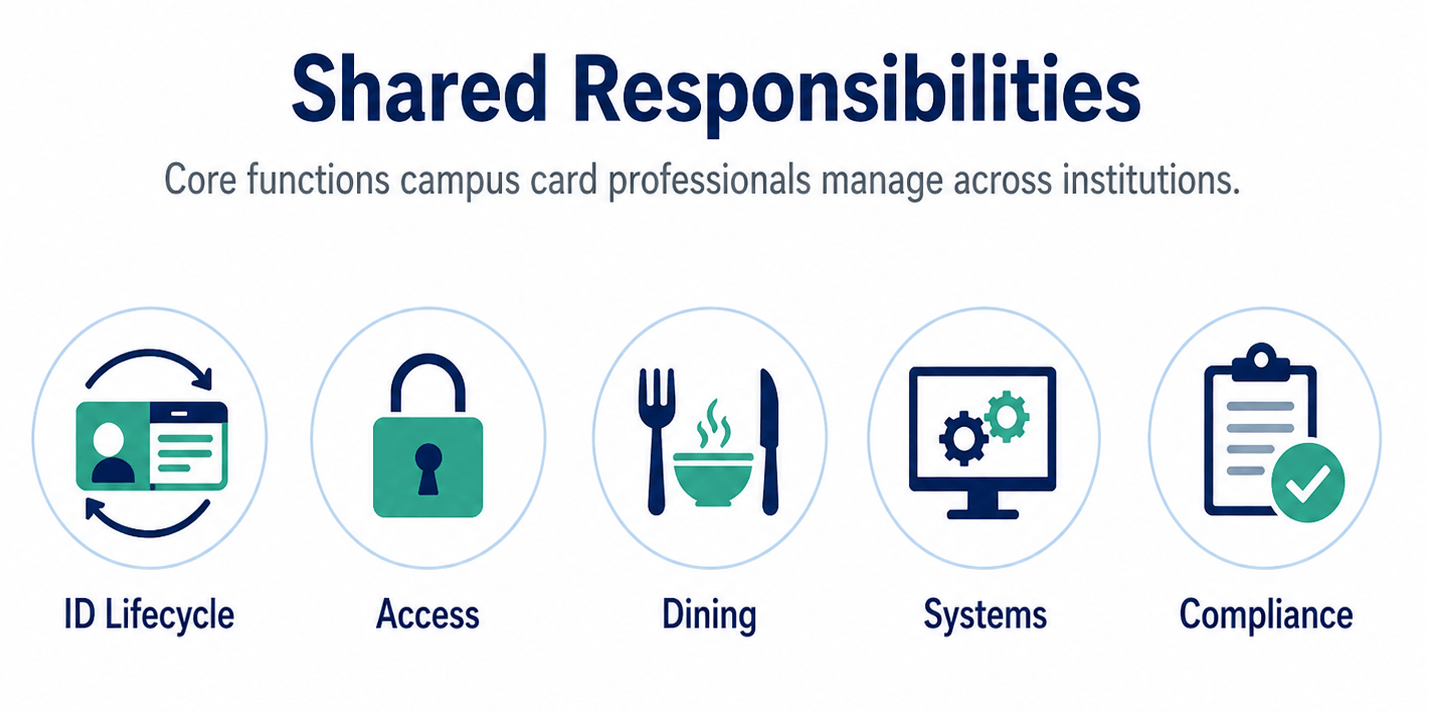
Shared Responsibilities
The scope of the campus card role varies by institution size, but the core responsibilities are remarkably consistent across the higher education landscape:
- Issuing, replacing, and managing the full lifecycle of photo identification cards for students, faculty, staff, and affiliates
- Administering declining balance and meal plan accounts, often reconciling transactions across multiple dining and retail partners
- Overseeing access control integrations and, coordinating with facilities, public safety, housing, and IT to determine who gets through which doors and when
- Managing vendor relationships for card production hardware, software platforms, and reader infrastructure
- Serving as the institutional bridge between the card system and enterprise platforms like the SIS, ERP, HR systems, and payroll
- Responding to lost, stolen, and compromised cards - often around the clock, especially during high-traffic periods like orientation, move-in, and finals
- Ensuring compliance with privacy regulations, accessibility standards, and institutional policy
- Training staff across campus who use card-adjacent systems, from dining cashiers to building managers
- Planning and executing system upgrades, card redesigns, and technology migrations
- Presenting program metrics, budget justifications, and proposals to institutional leadership
The Shared Experience
Beyond the job description, campus card professionals share a kind of experience that’s hard to put into a role posting but immediately recognizable to anyone who’s lived it.
They know the feeling of watching orientation week approach like a freight train: 4,000 new cards to issue, a printer that started behaving strangely on Thursday, and a line out the door before 8 a.m. They know what it’s like to be the only person on campus who understands why the door to the chemistry lab stopped working. And then to be expected to explain it to six different stakeholders with six different vocabularies.
They’ve all had the conversation where someone from another department asks, cheerfully, if the card office can “just add” a new feature - unaware that the request involves three vendor contracts, a middleware integration, and six months of testing.
The orientation sprint
Every campus card pro has a story about the first week of fall semester. It’s a rite of passage. It’s a stress test of every system, process, and staffing plan at once. And oftentimes we get through it by comparing the craziest stories with our colleagues from other institutions that have their own interesting story to tell.
The midnight call
A stranded student, a locked building, a system outage at the worst possible hour. Campus card professionals learn to be on call even when they’re officially not.
The “why didn’t we do this sooner?” upgrade
Whether it’s mobile credentials, a new vendor integration, or a new photo capture workflow, it’s the moment a long-fought modernization project finally goes live. And it is deeply satisfying.
The grateful student
Amid the complexity, there are moments that remind you why it matters that a student can now access the building they need, a family relieved by a late-night card reissue or even helping a new, shy student navigate campus life.
The Professional Community
One of the most consistent things campus card professionals share is the value they place on peer community. Conferences like NACCU’s Annual Conference are more than professional development - they’re reunions of people who immediately understand each other’s problems without needing to explain the context.
That shorthand is rare and worth protecting. In a role that can feel isolated on campus - too technical for student affairs, too service-oriented for IT - finding peers who get it is genuinely satisfying.
What Sets Great Ones Apart?
Within this shared foundation, what distinguishes the campus card professionals who thrive? Those who make a case for the campus card and constantly seek new ways to offer solutions to campus challenges.
It’s a combination of taking pride in the work, looking for “fixes” that come up in meetings and being interested in what’s new and how it works. The best in the field stay genuinely engaged with where the technology is heading (mobile credentials, biometrics, NFC, cloud-based access management) not because they’re required to, but because they find it interesting.
They also advocate, consistently and diplomatically, for their programs. They understand that a card office seen merely as an ID-printing window will be funded like one. The professionals who elevate their programs are the ones who help leadership understand the ins and outs campus card office. They make their case for the campus card. They find their champion.
And perhaps most importantly: they show up for each other. The campus card community is small enough to be genuinely collegial and large enough to be remarkably diverse in experience. That combination and the willingness to share, to ask questions without ego, to offer what you know - is maybe the most defining trait of all. Most of us call this “networking”, but deep down it feels more like family reuniting after some time apart.